HBO Has Committed a Decade to Hogwarts, and That Is the Real Story
The streamer has released an extended teaser for its Harry Potter series, but the number that matters is not the view count, it is the ten years the company has signed up for.
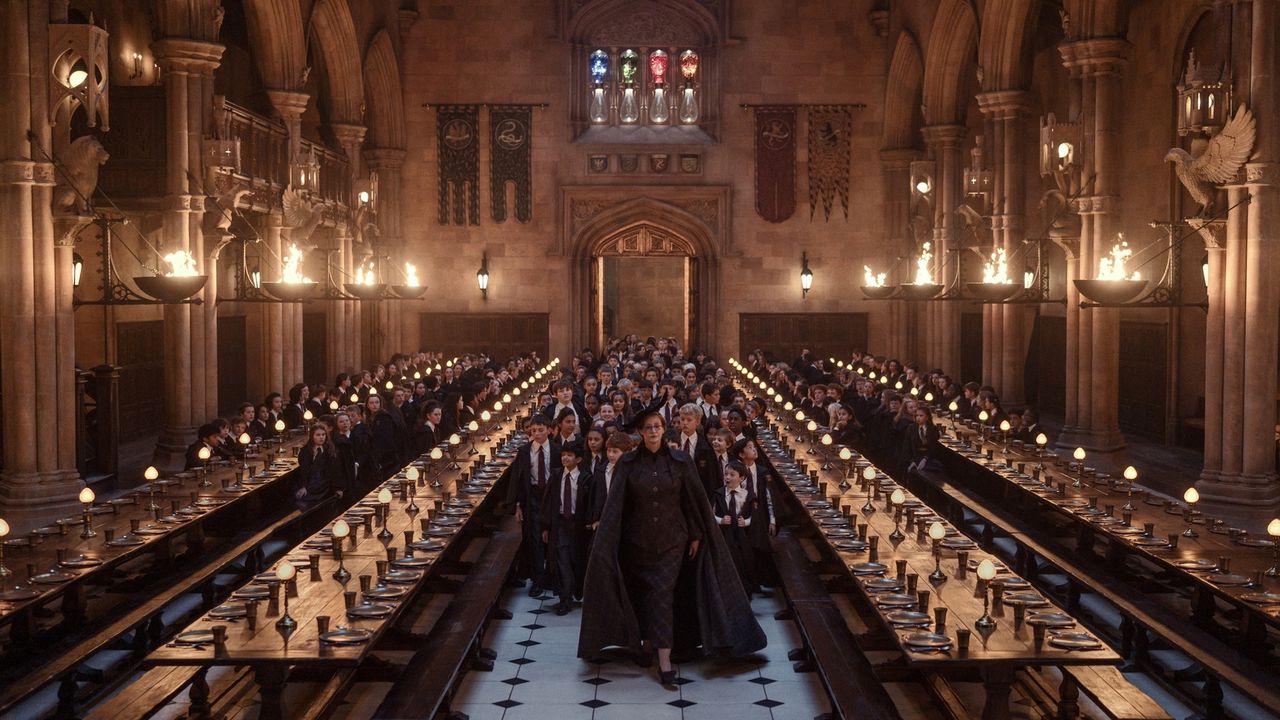
On September 2, HBO released a full-length teaser for the first season of its Harry Potter series, formally titled Harry Potter and the Philosopher's Stone. It follows a first teaser issued on March 25, 2026, and it is the clearest look yet at what the company has spent three years building.
The footage does what it needs to. The main trio travelling to Hogwarts. The sorting ceremony, including Harry's refusal to be placed in Slytherin. The welcoming feast, a wizard's chess game, the troll in the dungeon. Quidditch appears to carry considerably more weight than it did in the films. Characters who never got much screen time, Seamus Finnigan among them, are visible.
That is the marketing. The business decision underneath it is more unusual.
Ten years is not a normal commitment
The reboot was greenlit on April 12, 2023, at a Warner Bros. Discovery press event. The terms set out then were specific and, by the standards of streaming commissioning, extraordinary.
The series would adapt the original books rather than invent a new premise, with each season covering one book. The cast would be entirely new. The company described the run as decade-long, and said the result would be a faithful adaptation of the original novels.
A decade. Most streaming drama is commissioned a season at a time, with renewal contingent on completion rates inside the first fortnight. Committing publicly to a ten-year arc inverts that logic. It tells the audience the show cannot be cancelled underneath them, which is a real promise in a market where viewers have learned to expect the opposite, and it tells everyone else that the company has decided this property is infrastructure rather than content.
The cast would be entirely new, and the run would last a decade
Why they think the arithmetic works
The evidence for treating the franchise as durable is already in. The Wizarding World theme park at Universal Studios continues to perform. The Cursed Child stage production has run for years. The Fantastic Beasts films were contentious among the audience and still did the commercial job. Hogwarts Legacy, an open-world game released into a storm of discourse, sold enormously.
The property has, in other words, repeatedly demonstrated that it survives controversy and converts across formats. A studio looking at that record could reasonably conclude that the risk in a ten-year commitment is lower than the risk of leaving the asset idle.
The idea has been circulating a long time. As far back as January 2021 the streamer was holding meetings to find a writer for a potential series, well before anything was announced.
The people actually making it
The hires do not suggest a cautious production.
Francesca Gardiner is writer and executive producer. Her credits include Succession and Killing Eve as a producer, and His Dark Materials and The Man in the High Castle as a writer. That is a track record in prestige drama and in adapting difficult literary source material, which is precisely the problem a book-per-season structure creates.
Mark Mylod is an executive producer and director. His credits run from Entourage through Shameless to Game of Thrones. Holly Waddington, an Oscar winner, is costume designer.
None of those are franchise-management appointments. They are the people a company hires when it wants the result taken seriously as drama rather than delivered as brand maintenance.
What it signals for everyone else
The reason this matters beyond one show is what it says about where the streaming business has arrived.
The land-grab years rewarded volume: commission widely, cancel quickly, measure everything in completion rates. That produced a great deal of television and very little that anyone expected to still be watching in five years. What replaces it appears to be the opposite bet — fewer properties, far longer horizons, and a willingness to say out loud that a show will run for a decade.
Returning to Hogwarts fifteen years after the final film, and twenty-five years after the franchise began, is the most legible possible version of that strategy. It is also the most exposed. Ten years is long enough for a cast of children to grow up on screen, for audience taste to move, and for the company's own management to change twice.
The teaser will be judged on whether it looks right. The commitment behind it will be judged on whether anyone is still making season seven.
More from Media & Influence
France Has Built an Emergency Service for Independent Cinemas and Signed Up Twenty Directors
IRIS is designed to intervene quickly when a cinema, distributor or nonprofit network is at risk, on the argument that exhibition cannot relocate the…
Aaron Rodgers Says the Sports Media Turned on Him Over Covid, and One Analyst Has Answered
The quarterback argues that people who were friendly stopped being friendly once he took a position, and the analyst he named says that was never…
A Co-Hosted Podcast Has Come Back With a New Co-Host, Six Weeks After the Hosts Disagreed
Sophie Cunningham's show returns under a new name with a basketball trainer in the second chair, and neither she nor West Wilson has explained the…