At a Ceremony for the First Responders, the President Talked About Himself
Donald Trump used an event honouring the victims of September 11 to repeat claims about his own conduct that year for which there is no supporting evidence.
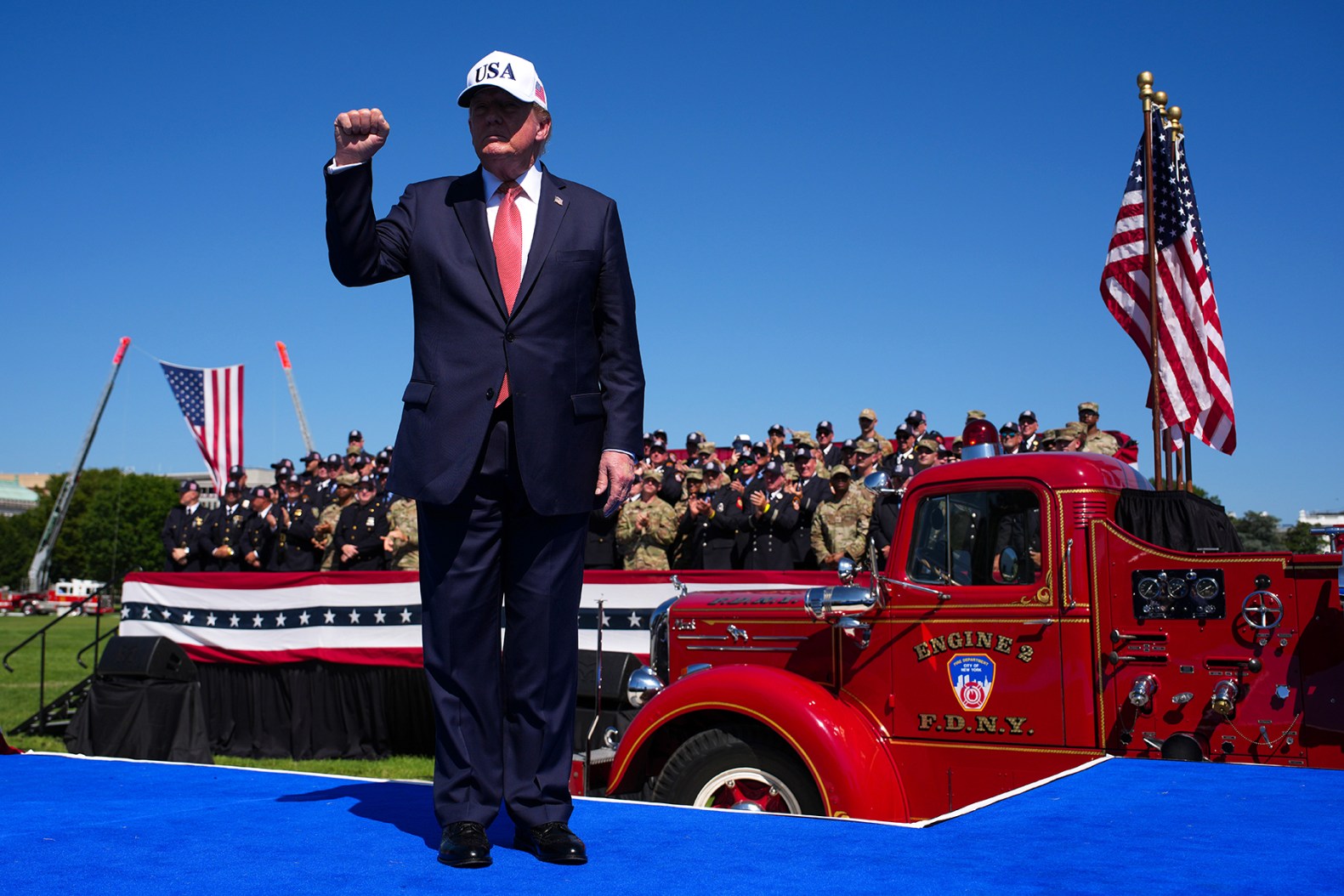
Nearly 3,000 people were killed in the attacks of September 11, 2001. The 25th anniversary falls this week, and on Tuesday the president attended an event intended to honour the first responders and the dead.
What he said there has become the story.
"I took the whole crew down there right after this happened," Trump said. "Everyone went down with me. We went down as a big group of people. There wasn't too much we could do."
There is no evidence that Trump visited Ground Zero in the immediate aftermath of the attacks. He also said that two firefighters had lifted him and carried him out of danger when they believed the United States Steel Building, which he described as creaking, was about to come down. There is no evidence for that either.
The medal, and the complaint attached to it
The same event included a genuine act of recognition.
Welles Crowther worked in the World Trade Center and is known as the Man in the Red Bandana. He led several people to safety before he was killed when the South Tower fell. Trump awarded him the Presidential Medal of Freedom posthumously, which is an entirely appropriate use of the honour.
He then said this about him.
"He's become more famous than me. I don't like it. I'm very unhappy. He's become much more famous than me."
That was said at a ceremony conferring the nation's highest civilian award on a man who died at 24 getting strangers out of a collapsing building.
He's become more famous than me. I don't like it
Where the anniversary was originally going to be held
Reporting published last month said the president had initially intended to mark the 25th anniversary at Ground Zero itself, and changed the plan after it became clear that politicians are not permitted to give speeches at the site.
Trump said the story was made up. He also described one of the reporters who wrote it as an unattractive person both inside and out, and called her a name.
The rule at the site is real and long-standing, and it exists precisely to keep the memorial from becoming a stage. Whatever the accuracy of the reporting about his intentions, the constraint it describes is not in dispute.
A pattern with a starting point
The reason all of this reads as a pattern rather than a bad afternoon is that there is a recording from the day itself.
On the morning of the attacks, Trump spoke by telephone to a radio station in Secaucus, New Jersey. He was asked whether his building at 40 Wall Street had sustained any damage.
"40 Wall Street actually was the second-tallest building in downtown Manhattan," he answered. "Before the World Trade Center it was the tallest. Then when they built the World Trade Center it became known as the second-tallest, and now it's the tallest."
The towers had fallen that morning. Thousands of people were dead or unaccounted for. Asked about his property, he noted that his building had been promoted.
Why it keeps mattering
September 11 occupies a particular place in American public life, and the expectation attached to it is not demanding. It asks a public figure to speak about other people for a few minutes.
The expectation is arguably higher for this president than for most. He was born in New York, built his name there, and has made the city central to his public identity for fifty years.
The difficulty is not that he says nothing about the victims. He did award Crowther the medal, and did describe what Crowther had done. It is that the account never stays on them. The first responders become the crew he took down there. The medal recipient becomes a man who is unfairly more famous than he is. The morning itself became, in real time, a fact about the height of a building he owned.
Twenty-five years on, the commemoration remains the same shape it was on the first day.
More from Politics
Trump Has Promised 500 Dollar Obamacare Refunds to About Five Per Cent of Enrollees
The White House says the previous administration overcharged people through exchange user fees, and has not produced evidence for the claim.
Trump Threatens to End Trade With Canada Altogether, and Ottawa Declines the Fight
Donald Trump has floated cutting off commerce with America's largest trading partner entirely, and the Canadian government's answer has been to…
The Republicans Held a Convention With Nobody to Nominate, and Half the Arena Was Empty
Donald Trump told the party's first midterm-year convention to imagine his name was on the ballot in November, and several of the candidates who need…